The Layers
Four layers, each one enabling the next.
Four layers, in sequence. Each one necessary. Together, they make the commons possible.
Part of our solutions framework — The Catalist Platform · OMNI-Mapping · Global Commons · Demos · Our Operating Model
A living knowledge commons where the work of mapping, understanding, and connecting doesn't start over for each new effort — it compounds.
Every community we've worked with has the same experience. They've built maps, catalogued resources, documented their ecosystem. Vital knowledge exists. It's just trapped — in the platform where it was created, invisible to the communities who need it most.
Thousands of organizations spend tens of billions annually on data collection and visualization. Yet the insights generated in one corner of the field never reach the practitioners working on the same problems three bioregions over. Frameworks are reinvented from scratch. Maps are rebuilt. Connections that should exist simply don't.
This isn't a problem of effort. It's a problem of infrastructure.
The root cause isn't a lack of data. It's the absence of connective tissue — a commons layer where knowledge can be contributed, discovered, and built upon across organizations, tools, and scales.
Organizations repeatedly develop ontologies, frameworks, and taxonomies from scratch — when the only real differentiator between them is the information organized within a specific lens. The work has already been done. It just isn't shared.
Vital resources are scattered across maps, tools, and databases with no shared layer connecting them. A community in one bioregion can't see the strategies that worked in another. The data exists. The bridge doesn't.
Communities want their knowledge to be useful beyond their own walls — but not at the cost of losing control over it. Without clear attribution, provenance, and stewardship protocols, contribution to any commons feels like a risk rather than a gift.
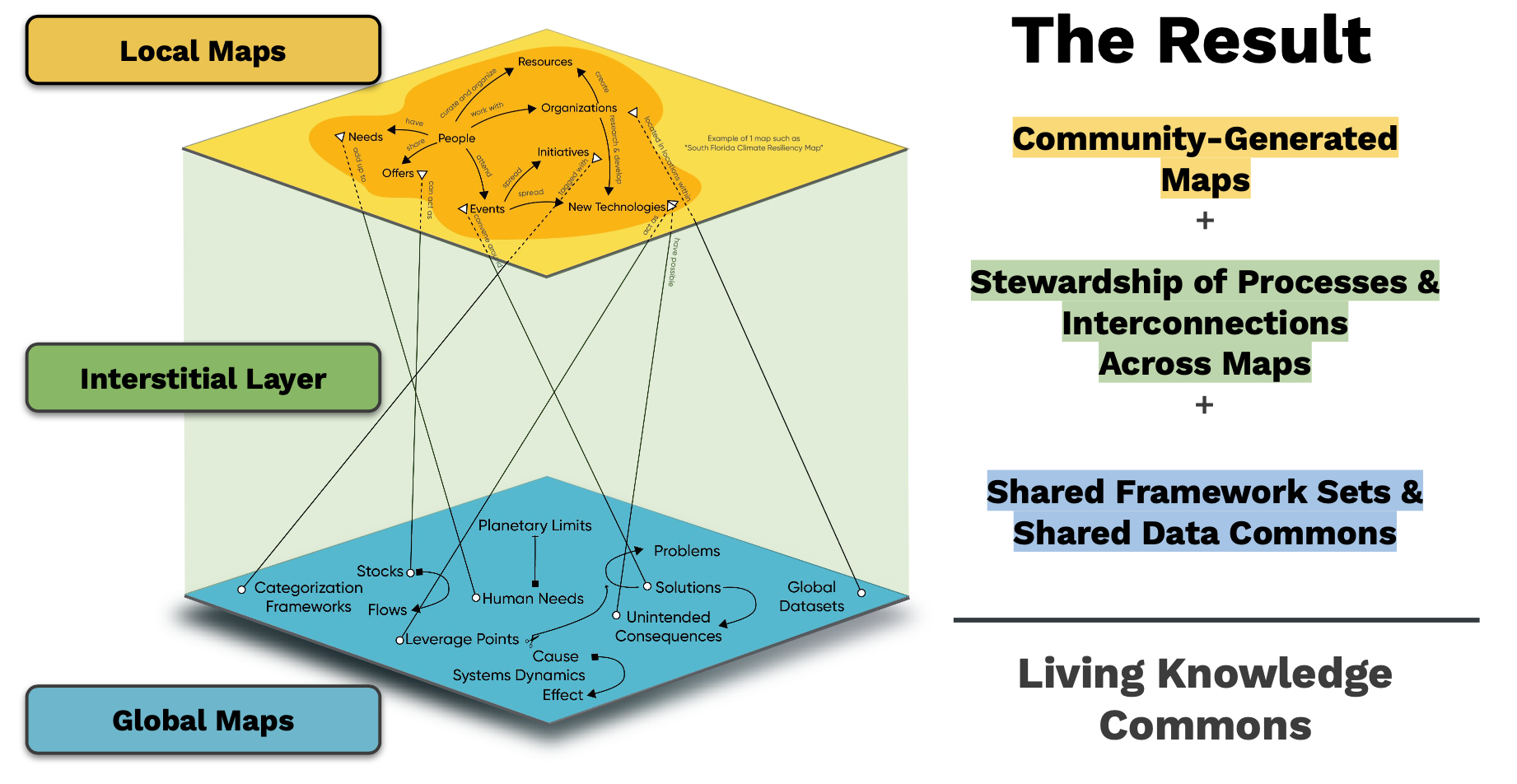
The architecture of the Global Living Knowledge Commons is built in sequence. Each layer enables the next — and together they create something no single layer could produce on its own.
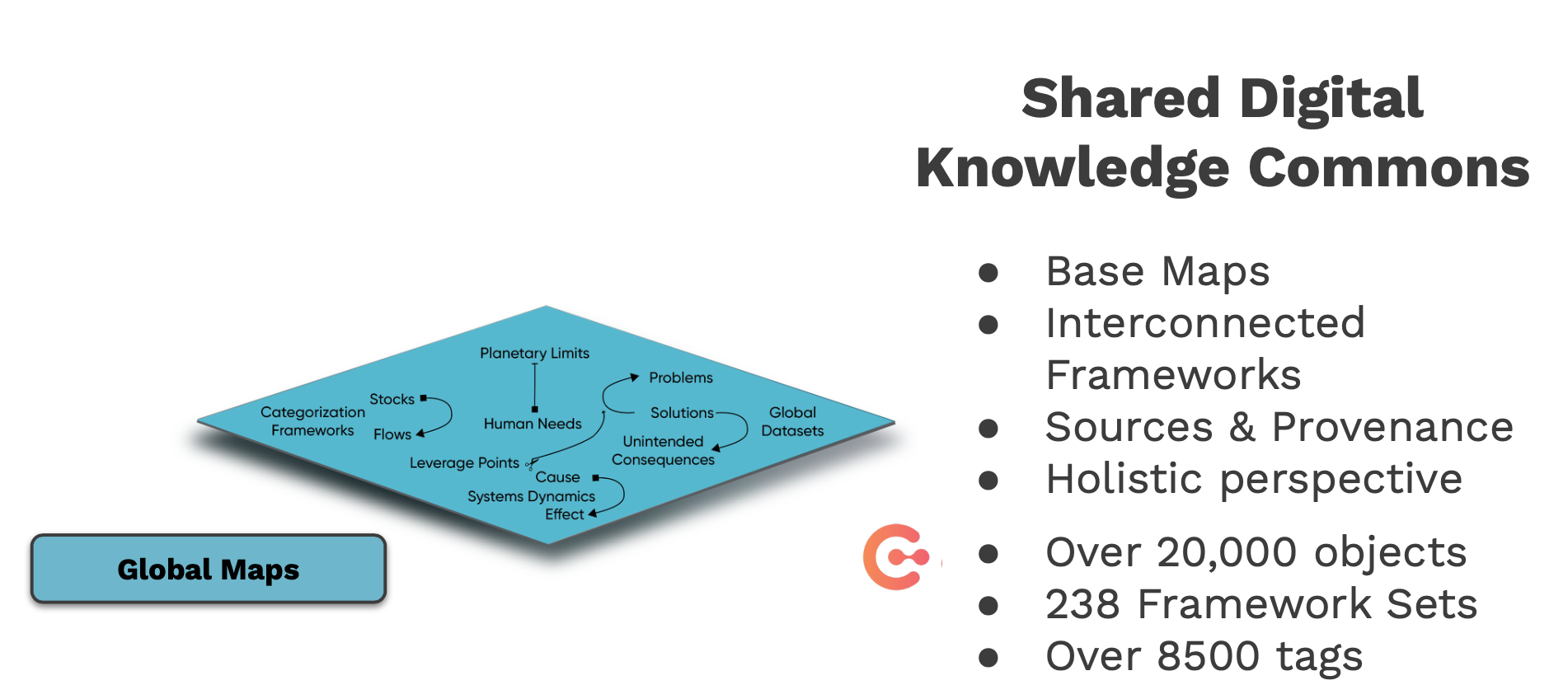
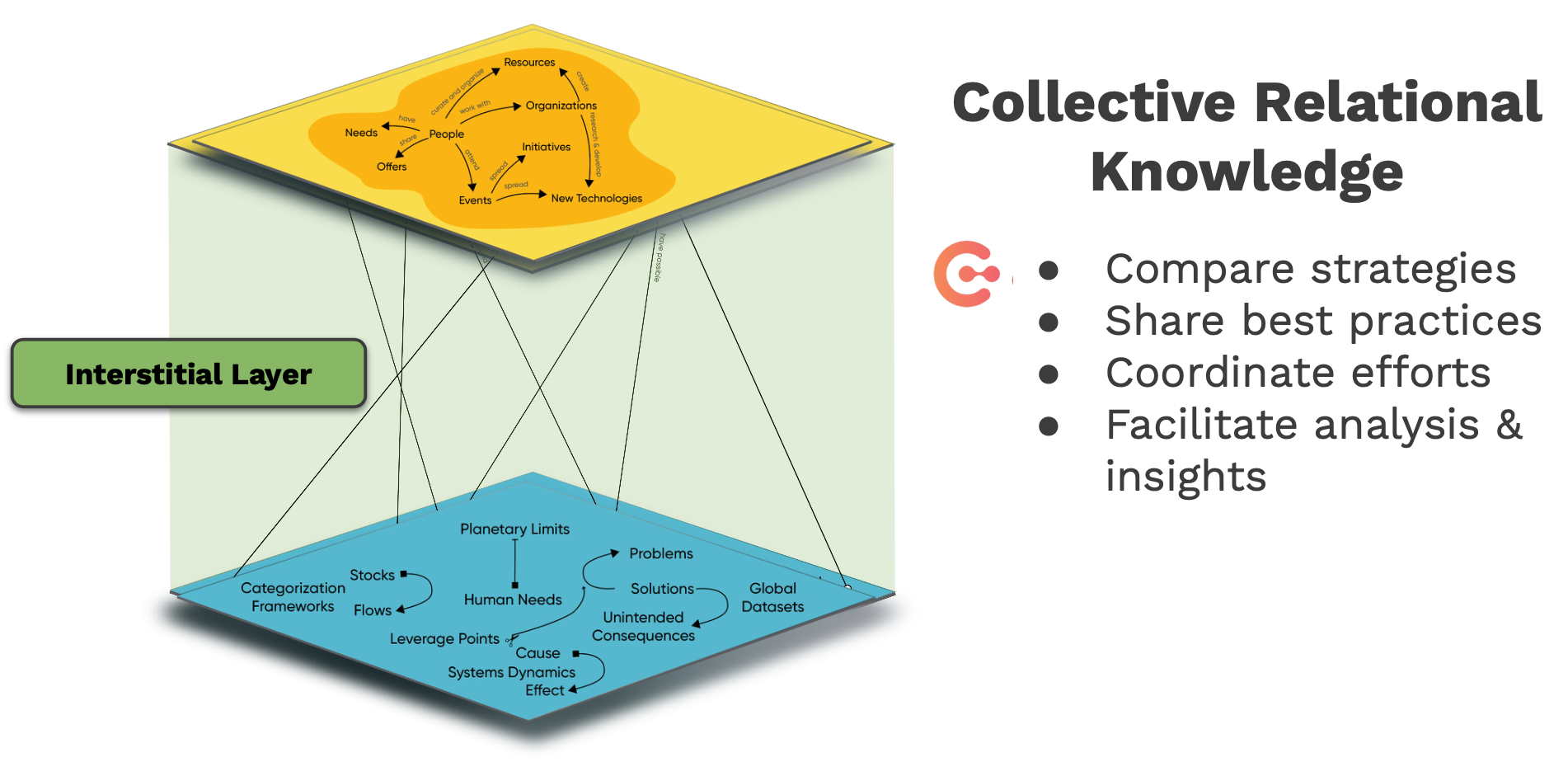
The first layer is the one communities already have: their own maps, tailored to their own goals, built in their own tools. The second layer is the shared knowledge infrastructure — a publicly accessible base of frameworks, objects, and tags that any community can draw from and contribute to. The third is what makes the first two useful to each other: the interstitial layer, where local conditions and global strategies can finally be seen in relation.
The result is a fourth thing: a living commons, where what communities learn compounds — rather than siloing, repeating, and disappearing.
Four layers, in sequence. Each one necessary. Together, they make the commons possible.
The commons is designed around tensions most infrastructure tries to eliminate. We don't resolve them by choosing a side. We hold both.
The Global Living Knowledge Commons is live and growing — built from three interlocking components that together make knowledge discoverable, reusable, and interoperable at scale.
232 frameworks — from SDGs to Project Drawdown to Doughnut Economics — transformed into a shared, AI-enhanced infrastructure. Organizations use the same lenses without reinventing them. Framework creators retain stewardship, versioning, and attribution rights.
A structured, searchable repository of 20,000+ public objects with provenance and attribution intact. Designed for cross-platform compatibility — so knowledge contributed in one tool can be discovered and reused in another, without duplication or loss of context.
Communities mapping their own ecosystems — bioregional regeneration, systemic finance, Indigenous knowledge systems — guided through a shared process of curating, tagging, and contributing their work into the commons. Local insight, global reach.
The Global Knowledge Commons is live. Explore 20,000+ interconnected objects across 238 framework sets, contributed by communities working toward a thriving world. This is what we've built — and it's growing.
Next solution
Field Notes →